



Batteries for Electric Scooters and Motorcycles
The fuel tank, control center, and the performance limiter in any e-scooter happen to be the battery for electric scooter, bringing the popularity of lithium-ion chemistries. They have much greater gravimetric and volumetric energy density than lead-acid. Light electric vehicles have a standard lithium-ion pack with 150-200 Wh/kg, and lead-acid batteries with 30-50 Wh/kg.
Thus, you can pack more watt-hours into a smaller, slimmer pack, keep weight low, and free designers to optimize balance, agility, and frame geometry. Their low mass cuts rolling and acceleration losses, and helps real-world range. Inherently lower internal resistance supports higher discharge rates and fast-charge capability alongside controlled heat generation. Hence, riders may exert powerful motors yet still recover useful range in short charging windows.
At the cell level, managed charge cut-offs, C-rates, and thermal envelopes let quality packs survive thousands of cycles with limited capacity fade. That stabilizes the daily range and total cost of ownership. All of this fits with e-mobility goals because a durable and efficient battery for electric scooter lowers material throughput and lifetime emissions per kilometer and makes electric two-wheelers handy as everyday and sustainable transport (not just short-hop gadgets).
What Is the Average Battery Lifespan?
How Long a Lithium-Ion Scooter Battery Usually Lasts
For most riders, a lithium-ion battery for electric scooter will give 5-8 years of useful life. That is equal to 1,500-2,000 full charge cycles, according to pack quality and chemistry. Frequent deep discharges, constant full 100% charges, very high C-rate acceleration, and parking the scooter fully charged in the hot sun all speed up aging. They stress the cell’s cathode lattice and grow the solid electrolyte interphase on the anode, which slowly steals active lithium. Cooler storage, partial charges (you may think about 20-80%), and letting the BMS manage cut-off voltages help slow this drift in capacity. As a result, the pack keeps a predictable range for more seasons.
How This Compares to Older Battery Types
Traditional sealed lead-acid and gel batteries in light vehicles might only manage a few hundred cycles, say up to 200, and 1-2 years of everyday use before their usable range drops sharply. That’s because they are more sensitive to deep discharge, heat, and sitting in a low state of charge. Lithium-ion packs outlast them by a factor of two or more in real-world service, along with higher cycle counts, lower self-discharge, and far less maintenance. That implies fewer replacements over the lifetime of the scooter and a lower total cost per kilometer ridden.
When Should You Replace a Battery?
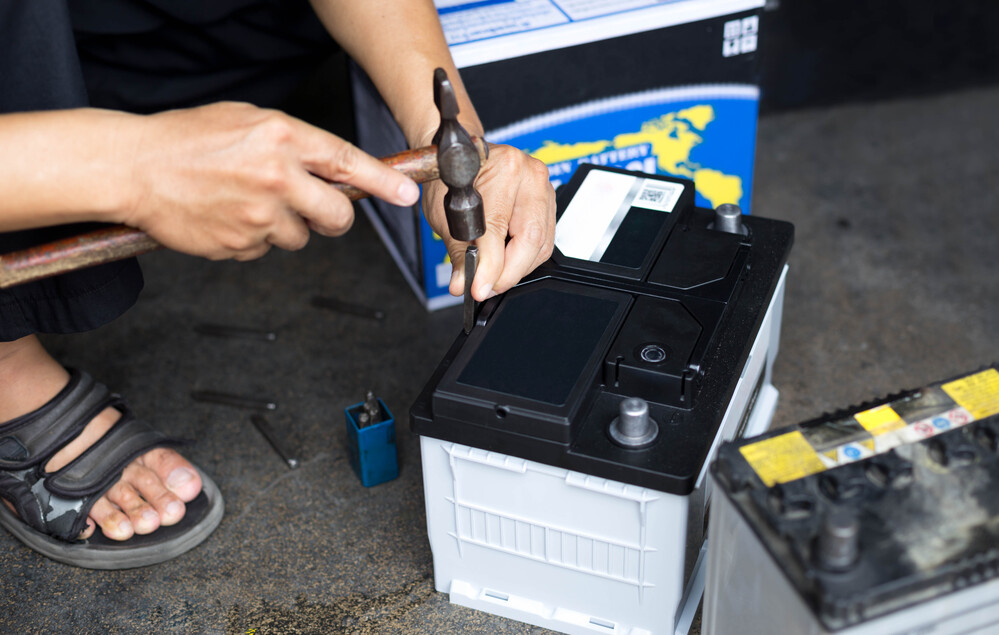
Common Signs That Indicate It’s Time for Replacement
- Decreased Range or Weaker Performance: Suppose you notice that your usual commute suddenly needs mid-trip charging. Or, the scooter bogs down on hills it used to climb easily. Then, the battery’s internal resistance has risen, as well as its usable capacity has dropped. Therefore, the motor can’t draw enough current without a big voltage sag. That’s a hint that your battery for electric scooter is nearing the end of its life.
- Technically speaking, different EV and energy-storage standards consider a lithium-ion pack “end-of-life” once its useful capacity drops to 70-80% of the initial rating. In everyday riding, that feels like losing roughly a quarter of your original range.
- Battery No Longer Holding Charge: When the pack shows “full” but the gauge falls fast, or when it self-discharges a lot just sitting for a day or two, that implies some cells in the series string are aged or imbalanced. So, the BMS has to cut off early to save the weakest ones. You also see short runtime, long charging sessions, and sudden power cuts under load. These are all signs to schedule a replacement rather than keep chasing chargers.
- Overheating or Swelling and Other Red Flags: If the pack gets unusually hot during riding or charging, smells strange, makes crackling noises, or shows any swelling of the casing, stop using it. Remember, gas build-up and deformation are owing to serious internal damage and a real risk of thermal runaway, fire, or explosion. A swollen or scorched pack should go straight to recycling and be replaced (not tested one more time).
Safety and Maintenance to Delay Replacement
To keep a new battery for electric scooter healthy for as long as possible:
- Use the original or certified charger.
- Avoid running it near empty.
- Charge in the mid range rather than parking it at 100% for days.
- Keep it away from direct sun or freezing garages.
- Store it around half charge in a cool, dry place when you won’t ride for a while.
Keep in mind that a modest charge, slow charging rates, and stable temperatures all slow down the chemical wear that makes a replacement necessary.
Upgrade Your Electric Ride with Molicel Batteries
We’re happy to introduce the INR-21700-M65A, our flagship cell at Molicel. It suits your battery pack, whether you’re designing a high-performance motorcycle or a little city car. In its 21700 format, it has a capacity of 6.5 Ah at a nominal 3.6 V and an energy density of 322 Wh/kg (943 Wh/L). It gives you a greater riding range without the extra weight or volume.
Plus, it can tackle a continuous discharge current of 26 A, which assures high acceleration and steady performance. It can also handle more than 1,000 full-charge cycles to make it reliable. This is important when you need a high-quality battery for electric scooter or other LEV use.
We think that spending money on advanced engineering is worth it. The INR-21700-M65A isn’t simply a cell; it’s the basis for a long-lasting power source for your vehicle. Riders can go farther and help with sustainable mobility without giving up anything, as it has a better range, readiness, and cycle life. So, our premium cell lets you select smarter, ride longer, and move greener.
Electric Scooter Battery FAQ
Q1: How do Molicel battery cells enhance electric scooter speed, range, and hill-climbing power?
A: Molicel ultra-high power cylindrical cells (such as the 21700 P45B and P50B series) offer exceptional energy density and high continuous discharge currents. This combination ensures sustained power delivery to the scooter motor during heavy acceleration and steep hill climbs without severe voltage sag, maximizing both top speed and total riding range.
Q2: Why is Molicel’s low internal impedance crucial for electric scooter battery safety and thermal stability?
A: Electric scooter battery packs are enclosed in compact compartments prone to heat accumulation. Molicel cells are engineered with ultra-low internal impedance, which minimizes heat generation during high-drain operation and fast charging. Reduced thermal stress prevents cell degradation, ensures pack safety, and drastically extends battery service life.
Q3: What makes Molicel lithium-ion cells superior to standard battery cells for daily e-scooter commuting?
A: Molicel cells deliver outstanding cycle life, fast-charging capabilities (up to 5C), and excellent structural durability against road vibrations. Commuters benefit from rapid turnaround times between rides, predictable capacity retention over years of daily charging, and reliable performance across wide operating temperature ranges.