


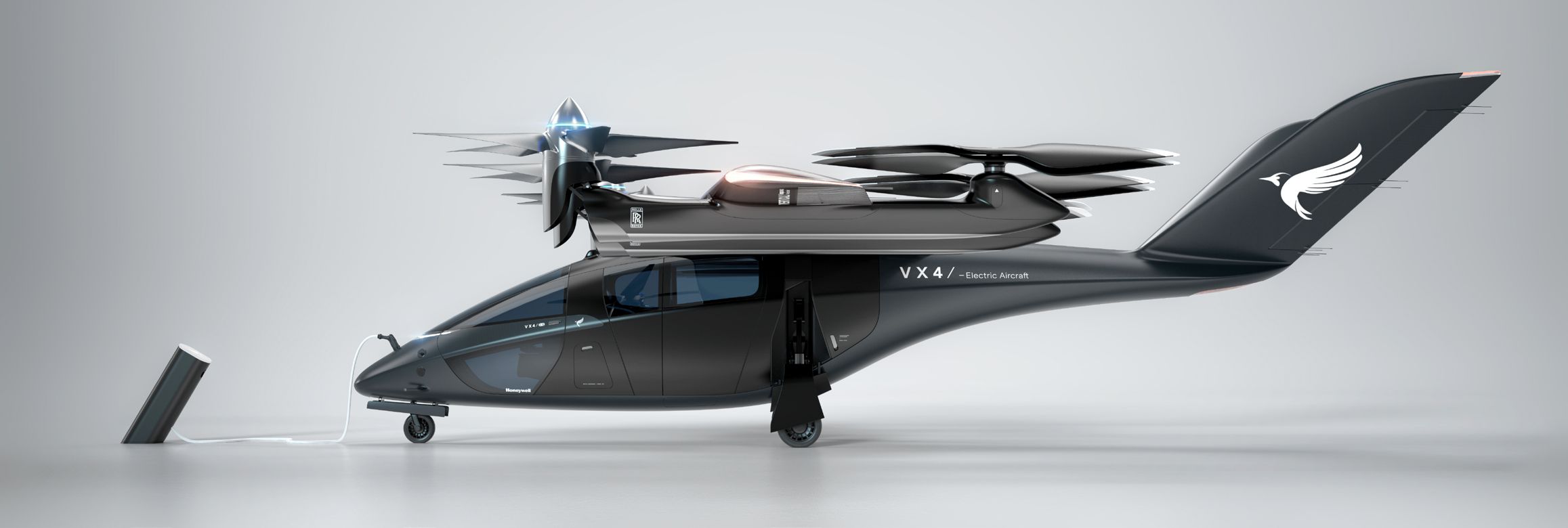
What Is an eVTOL?
An eVTOL is an aircraft that lifts off vertically like a helicopter but runs on electric motors instead of fuel. It uses rotors or ducted fans to push air downward for lift, then tilts or redirects that thrust to move forward. Because it skips the runway, it can operate from rooftops or small pads in crowded cities. The motors draw power from a high‑capacity eVTOL battery tucked inside the airframe, so engineers focus on weight and heat as much as aerodynamics.
Electric drive cuts direct emissions and lowers noise, though current designs still face limitations on range and payload capacities. Many prototypes use several small propellers for redundancy, which lets them keep flying if a motor quits. Regulators are drafting regulations to certify these machines, and test flights have demonstrated smooth, quiet climbs. Nevertheless, large‑scale passenger service will depend on proving safety, cost, and fast charging at vertiports.
How Are eVTOLs Powered?
Most eVTOLs draw their lift and cruise power from high‑voltage lithium‑based packs that feed independent electric motors through solid‑state power distribution units. Each pack is sized for flight energy and reserve margins set by regulators. Designers juggle energy density, weight, and thermal limits to hit a usable range and climb rate; liquid cooling plates or air channels pull heat away from cells and inverters to keep everything under 45°C. Lithium‑nickel‑manganese‑cobalt gives 280 Wh kg⁻¹, which can mean a few minutes of urban hop plus reserves. Consequently, some projects use a small turbine‑generator or hydrogen fuel cell as a “range extender” to charge packs during the voyage, letting motors remain electric and distributing weight equally.
Motor controllers use wide‑band‑gap silicon‑carbide transistors for efficiency, and the distributed propeller layout means each rotor has its own inverter, battery string, and high‑speed data link to a flight computer that handles torque balancing and fault isolation in milliseconds. That prevents a single failure from dropping the vehicle. Finally, charging happens either through fast‑DC ports on the landing pad or by hot‑swapping modules. Charging strategies keep the eVTOL battery between 20% and 80% state‑of‑charge to extend cycle life for commercial service.
What Batteries Do eVTOLs Use?
High Energy Density Keeps Weight Down
An eVTOL needs to lift itself straight up so every kilogram counts. Lithium‑ion cells carry more watt‑hours per kilogram than other rechargeable chemistries now in volume production. That high energy density lets designers keep rotor size small, improve climb performance, and still hit the range targets set by regulators. It also simplifies thermal management because fewer cells generate less waste heat. The chemistry tolerates deep discharge cycles, which helps preserve usable capacity over the life of an eVTOL battery while keeping pack size modest. Maintenance crews also value the familiar monitoring hardware already proven in drones and electric cars. In short, lithium‑ion wins because it packs the most energy where weight hurts the most.
Fast Charging Keeps Aircraft Available
Quick turnaround is key for a rooftop vertiport with back-to-back flights. Lithium‑ion cells accept high charge currents without forming memory effects, so operators can restore 80% state‑of‑charge in thirty minutes or a bit longer on today’s megawatt chargers. That lets aircraft earn revenue instead of sitting idle. With liquid cooling, short charging bursts do not exceed cell temperatures due to the chemistry’s steady impedance profile. Predictable charge behavior simplifies scheduling software and grid forecasting. Over a year, these saved minutes add up to many more sorties per eVTOL battery, boosting fleet economics without airframe change.
How to Choose Batteries for eVTOLs
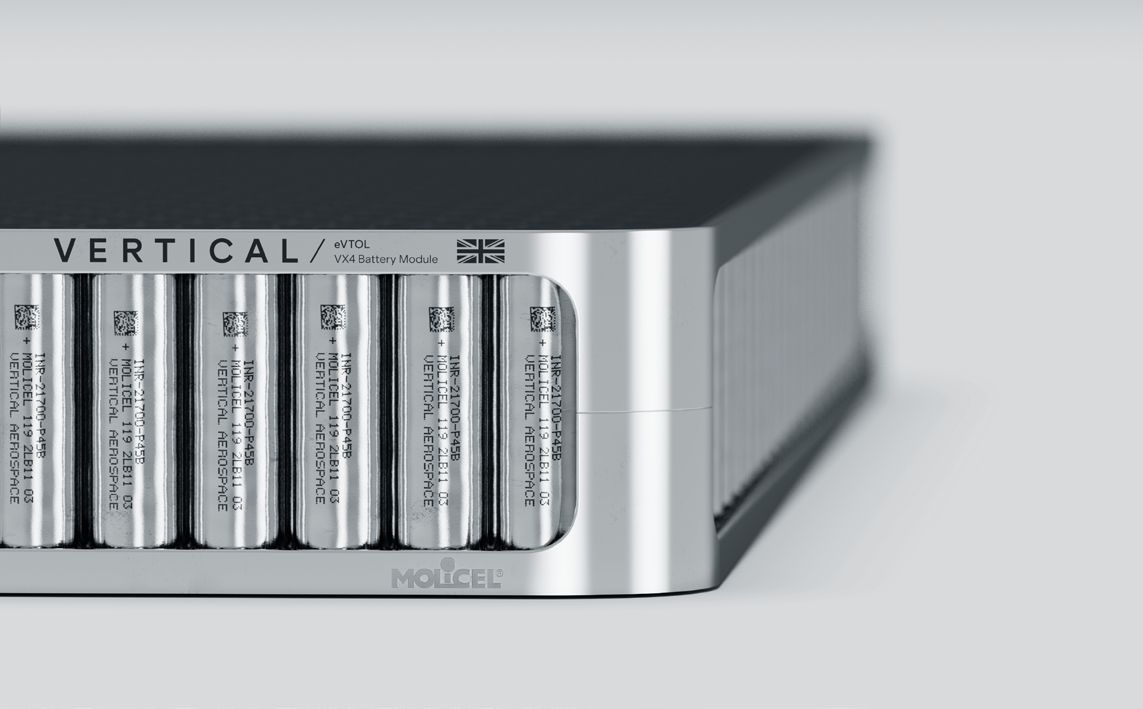
- Battery Chemistry: When thinking about your eVTOL battery, start with chemistry. Lithium‑ions are common, but there are flavors. High‑nickel cells give more energy; lithium‑titanate offers fast charge and long cycle life at the cost of weight. Safety matters, so look for chemistries with stable cathodes and thermal management. Match the cell type to how often you will charge, discharge depth, and temperature range.
- Voltage: Voltage sets how the eVTOL battery talks to motors and inverters. Higher pack voltage cuts current for the same power, trimming cable weight and heat losses. It also lets power electronics run more efficiently. At the same time, as voltage rises, insulation, connector spacing, and maintenance demands grow. Choose a voltage that balances efficiency gains with practical limits on safety and system complexity.
- Capacity: Capacity tells you how long the eVTOL battery can keep you aloft while leaving reserve for diversion and hover. More amp‑hours add minutes of flight and kilograms of mass. Use mission analysis to find the smallest capacity that still meets takeoff, cruise, loiter, and emergency needs. Plan for aging: cells lose capacity over cycles, so size the pack with end‑of‑life performance in mind, not day‑one specs.
- Energy Density: High energy density means the eVTOL battery adds less mass per kilowatt‑hour to boost payload and range. Look at both gravimetric (Wh/kg) and volumetric (Wh/L) figures since cabin layout matters too. Pack‑level density will be lower than cell‑level, so account for cooling plates, fire barriers, and containment. Optimize structure, wiring, and enclosures to preserve the raw cell energy density.
The Best Batteries for eVTOL
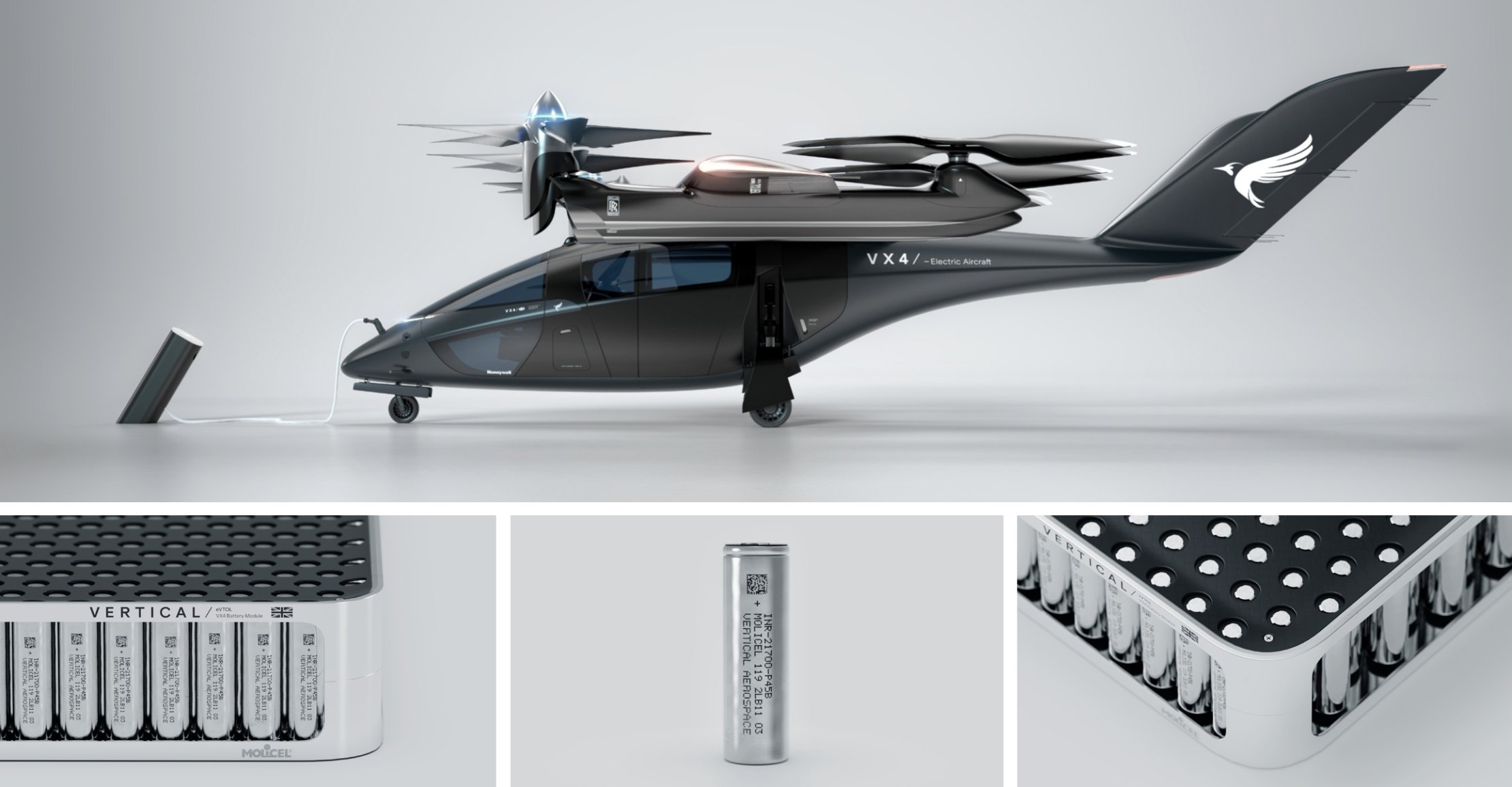
At Molicel, we have engineered our lithium-ion cells for eVTOL applications to deliver high power, safety, and efficiency. For instance, our INR-21700-P45B cell offers a nominal voltage of 3.6V, a capacity of 4.5Ah, and a maximum continuous discharge current of 45A. It attains a peak power output of up to 184W for 10 seconds at 90% state of charge, coupled with a high energy density of 643 Wh/l. This exceptional power-to-weight ratio is crucial for eVTOL aircraft, which require rapid, massive power delivery during the critical takeoff and landing phases. Our strategic collaboration with Vertical Aerospace on the VX4 eVTOL aircraft demonstrates our deep commitment to advancing this sector.
The advanced architecture of our cylindrical cells ensures high structural integrity and thermal isolation, significantly lowering the risk of thermal propagation across the battery pack. Furthermore, our ultra-low impedance platform supports high-rate continuous power discharge and fast-charging capabilities, maximizing operational efficiency and cycle life for eVTOL fleets.
If you want to learn more about Molicel’s eVTOL battery solutions, click here.
eVTOL Battery Technology FAQ
Q1: Why are Molicel ultra-high power cells essential for eVTOL aircraft applications?
A: Molicel ultra-high power cells, such as the INR-21700-P50B (260 Wh/kg) and P45B, provide the unique combination of high continuous discharge current and high energy density required for eVTOL flight profiles. Molicel technology delivers maximum power during energy-intensive vertical takeoff and landing while preserving range during cruise flight.
Q2: How does Molicel’s low internal resistance design improve safety and performance in eVTOL battery packs?
A: Molicel engineers its cells with ultra-low internal impedance (~13 mΩ) to minimize resistive heat generation under high-current discharge. This low-resistance design helps maintain stable voltage under extreme thrust demands, reduces thermal management overhead in flight, and supports rapid 5C charging to minimize eVTOL turnaround times on the ground.
Q3: What safety standards and technical advantages make Molicel battery cells ideal for electric aviation?
A: Molicel battery cells undergo rigorous quality control and thermal runaway safety testing, engineered to maintain high structural and chemical integrity under extreme loads. With proven real-world performance in high-altitude and racing applications, Molicel provides eVTOL manufacturers with high consistency, long cycle life, and low thermal propagation risk required for aviation safety certification.